
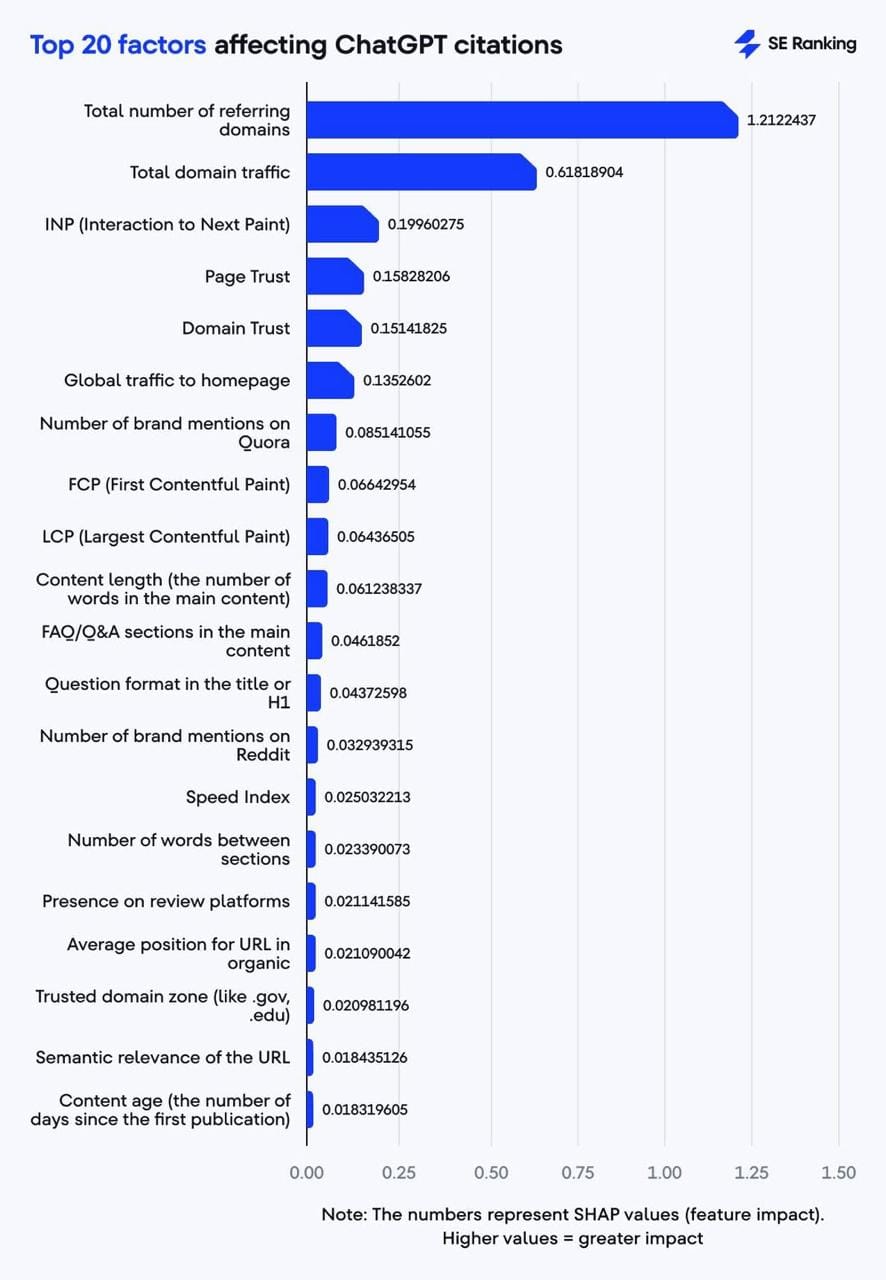
A recent study from SE Ranking analyzed more than 129,000 websites to understand why ChatGPT decides to cite certain pages in its responses. The findings reveal that AI citations are not random. They follow patterns tied to trust, authority, content depth, technical performance, and real-user signals.
Below is a complete breakdown of the 20 most important factors, presented in a simple, easy-to-understand format.
1. Referring Domains: The Strongest Predictor
Referring domains, the number of unique websites linking to yours, are the single strongest signal influencing whether ChatGPT cites a domain. Generative models rely heavily on signals that reflect broad, ecosystem-level trust. When many different sites link to a domain, AI models learn that the content is widely referenced and dependable. What the data shows:
- Around 2,500 referring domains correlate with roughly 1.6 to 1.8 citations
- Domains with more than 350,000 referring domains average 8.4 citations
- A major jump occurs around 32,000 backlinks, pushing citations from 2.9 to 5.6
Unlike outbound links, which have almost no impact, inbound links strongly influence AI trust. This mirrors classic SEO principles.
Takeaway: Build a diverse and high-quality backlink profile. More domains linking to you = stronger AI trust.
2. Total Domain Traffic: Real-World Legitimacy for AI
High traffic is strongly correlated with more AI citations. Even though ChatGPT does not “read” Google directly, large traffic volumes signal that humans trust and consume the content frequently. What the data shows:
- Domains under 190,000 monthly visitors: ~2–2.9 citations
- Domains above 10 million visitors: ~8.5 citations
Interestingly, extremely low traffic and medium traffic tend to be treated similarly if other factors are equal. Only truly high-traffic domains break away from the pack.
Takeaway: Traffic is not just good for SEO. It’s a real-world relevance signal that AI systems reflect indirectly.
3. INP (Interaction to Next Paint): Responsiveness Matters
INP measures how responsive a page feels when users interact with it. ChatGPT does not crawl your site live, but INP strongly influences user behavior patterns that appear in its training data.
A site that responds smoothly feels more trustworthy, while extremely simple pages (with extremely low INP) may lack depth and substance. What the data shows:
- INP <0.4s performs worse (~1.6 citations)
- Moderate INP performs best (~4.5 citations)
This suggests that pages need both responsiveness and depth.
Takeaway: Do not over-optimize for minimalism. Keep your site responsive, but rich in content.
4. Page Trust: Page-Level Authority Still Matters
Page Trust reflects the authority of an individual page. Even if your domain is strong, specific URLs still compete for AI visibility inside AI reasoning.
Pages with more backlinks, internal links, or deeper content become more “visible” inside AI semantic memory. What the data shows:
- Page Trust above 23 improves citation probability
- Page Trust above 28 averages around 8.2 citations
Takeaway: Strengthen key pages with internal links, data updates, and page-level backlinks.
5. Domain Trust: Global Reputation of the Entire Site
Domain Trust measures how credible your whole website is. ChatGPT favors domains that consistently appear in authoritative contexts rather than isolated pages. What the data shows:
- DT below 43 → almost never cited
- DT above 77 → citations start rising
- DT above 90 → citations increase dramatically
The domain extension (.gov, .edu) does not offer special advantages.
Takeaway: Build domain reputation through consistent quality, external references, PR, and strong backlink patterns.
6. Global Homepage Traffic: Where Brand Strength Shows
Homepage traffic is a brand signal. When many visitors land on a homepage directly or consistently, AI systems interpret that as a sign of strong brand presence. What the data shows:
- Homepages with over 7,900 monthly visits show the highest likelihood of being cited
Takeaway: Optimize your homepage as your brand’s credibility anchor.
7. Quora Mentions: One of the Most Powerful Social Proof Signals
Quora is a major information source inside AI training datasets. Mentions on Quora act as “crowd-validated expertise signals.” What the data shows:
- 0 → 33 mentions → ~1.7 citations
- Millions of mentions → ~7 citations
Takeaway: Participate on Quora. Provide helpful answers that naturally create brand mentions.
Other Factors That Still Influence ChatGPT Citations
Below are additional ranking factors with smaller but still meaningful impact. They work together as secondary signals that help AI models assess quality and trustworthiness.
8, FCP (First Contentful Paint)
FCP measures how quickly the first piece of content appears when a user loads your page. Pages that show something immediately feel more trustworthy and reduce bounce rates. Those behavioral signals often leak into the datasets large models learn from.
In the research, pages with FCP below 0.4 seconds earned around 6.7 citations, while slower pages dropped significantly. A slow start does not just hurt SEO performance. It also reduces how often AI encounters or retains your content.
9, LCP (Largest Contentful Paint)
LCP captures how long it takes for the main content block to fully load. When the core of a page loads quickly, users scroll more, interact more, and stay longer.
Models trained on high-quality data tend to associate strong LCP with pages that maintain stable structure and relevance. A consistent LCP makes a site look more polished in both human and AI-driven evaluations.
10, Content Length
Longer articles often correlate with higher citation counts because they naturally contain more depth, context, and examples. The data shows a steady trend: pages under 800 words average 3.2 citations, while pages above 2,900 words reach around 5.1 citations.
The key is not to stretch content artificially but to expand it meaningfully with research, insights, and unique angles. AI prefers pages that feel complete.
11, FAQ Sections
FAQs help large language models understand intent, context, and question formats quickly. Even though standalone FAQ pages are not strong citation magnets, missing FAQs at the end of long, detailed articles is a negative signal.
A compact FAQ block improves scannability and helps AI map the page to common user queries, which increases the likelihood of being cited.
12, Question-Format Titles
Titles phrased as natural questions align well with how users prompt ChatGPT. This small detail creates a stronger semantic match between your content and user intent. For informational searches, question-style titles slightly increase the chance that an AI model recognizes your page as a good answer candidate.
13, Reddit Mentions
Reddit is heavily represented in LLM training corpora. When a brand or page is mentioned across Reddit threads, the model becomes more familiar with it, and this familiarity improves trust signals indirectly.
More mentions do not guarantee citations, but they significantly increase the probability that a model “knows who you are.”
14, Speed Index
Speed Index reflects how quickly the visible parts of a page load. A low Speed Index creates a smoother reading experience, which usually leads to better engagement metrics. AI models indirectly inherit these quality signals, and pages with poor UX tend to appear less frequently in training sources. Optimizing it is an easy win for both SEO and AI visibility.
15, Words Between Sections
ChatGPT performs better with content that is broken into well-sized sections. When sections are too short, the content feels shallow. When they are too long, the page becomes harder for a model to segment into meaningful ideas.
The research shows that sections around 120 to 180 words strike a balance between depth and clarity, making the structure easier for AI to interpret.
16, Presence on Review Platforms
Appearing on platforms like Trustpilot, G2, Capterra, or Sitejabber signals that your business is real, active, and validated by customers. Pages and domains listed across multiple review platforms achieved between 4.6 and 6.3 citations, while those with no presence averaged around 1.8.
These platforms act as external trust anchors in both SEO and AI evaluation.
17, Average Google Ranking
Although ChatGPT does not fetch results from Google, its training data overlaps heavily with content that ranks well. Sites ranking in positions 1 to 45 averaged roughly 5 citations, while those in positions 64 to 75 dropped to around 3.
If you rank well on Google, you already share many of the same quality traits AI looks for: authority, depth, clarity, and trustworthiness.
18, Trusted Domain Extensions (.gov, .edu)
Surprisingly, domain extensions like .gov or .edu do not create a notable advantage. The research shows that ChatGPT favors content strength, domain authority, and user signals more than the prestige of a domain suffix.
In other words, what you publish matters far more than what your domain ends with.
19, Semantic Relevance of URLs
Clean, descriptive URLs improve both human and AI understanding of your page’s topic. Keyword-stuffed URLs often perform worse because they look unnatural and reduce clarity.
The model assigns more confidence to pages where the URL clearly reflects the content without unnecessary optimization tricks.
20, Content Age and Updates
Recent updates significantly improve citation potential. Pages updated within the past three months reached around 6 citations, outperforming both brand-new but unstated pages and older content left untouched.
ChatGPT prefers “alive” content that evolves with new data, trends, and context. Updating high-traffic or high-authority pages quarterly is one of the most effective and sustainable boosts you can make.
Conclusion
Across all 20 factors, the pattern is clear: ChatGPT cites websites that demonstrate consistent authority, trustworthy content, technical stability, and meaningful real-world signals. There is no secret trick. Just like SEO, AI visibility rewards websites that are genuinely valuable.
If you continue to invest in high-quality content, clean backlinks, stable performance, and brand presence across the web, your chances of appearing in AI-generated answers will naturally increase. Optimizing for AI is now as important as optimizing for Google. In the new era of search, appearing inside ChatGPT answers is becoming one of the most powerful distribution advantages a brand can have.
FAQs
Why does ChatGPT cite some websites more than others?
Because the model relies on trust signals like backlinks, traffic, page structure, and content depth. Sites with stronger authority and clearer information are more likely to appear in its reasoning.
Do technical metrics like FCP or INP really matter for AI citations?
Yes. They shape user experience and engagement patterns, which heavily influence the datasets used to train AI models. Faster, more stable pages are treated as more reliable.
Does longer content always mean more citations?
Not always, but deeper content gives ChatGPT more context, more facts, and more reasoning paths to reuse. Length alone doesn’t help, but depth does.
Does updating old content actually increase the chance of being cited?
It does. Fresh, recently updated pages consistently outperform both new but untouched content and older pages that haven’t been revised for a long time.
Do review platforms like G2 or Trustpilot affect AI visibility?
Yes. They provide strong legitimacy signals, telling the model that your business is real, active, and trusted by customers.
Do .gov or .edu domains get an advantage?
Not really. The study shows no meaningful difference. Content quality and authority matter far more than the domain extension.
Does appearing on Reddit or Quora help with AI visibility?
It helps indirectly. Those platforms appear heavily in training data, so more mentions increase familiarity and trust-weight for your brand.